

Smart Home Appliances Market Revenue to Increase at a 10.9% CAGR Through 2035
Smart Home Appliances Market
Smart Home Appliances Market Size, Share and Research Report: By Product (Refrigerator, Dishwasher, Washing Machine, Air Conditioner), By Technology
Smart Home Appliances Market: Accelerating as energy-efficient, Wi-Fi-enabled, and AI-driven home automation becomes standard in modern residential living.”
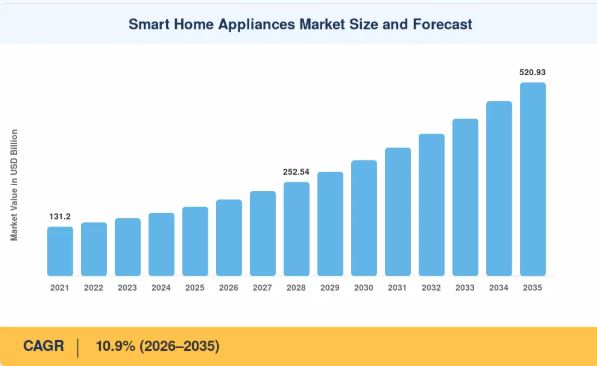
NEW YORK,, NY, UNITED STATES, August 10, 2026 /EINPresswire.com/ -- The Global smart home appliances market reached an estimated USD 185.14 Billion in 2025 and is projected to grow from USD 205.34 billion in 2026 to USD 520.93 billion by 2035, registering a CAGR of 10.9% during the forecast period. Two major catalysts are accelerating this trajectory: the mass-market adoption of voice-assistant ecosystems including Amazon Alexa, Google Home, and Apple HomeKit that have unified previously siloed appliance categories under intuitive control interfaces, and the surging consumer appetite for energy management solutions as residential electricity costs across OECD economies climbed an average of 18.4% between 2022 and 2024. With over USD 2.8 trillion in cumulative residential construction and renovation spending projected globally through 2035, homeowners and property developers face mounting pressure to integrate smart appliance infrastructure from the ground up.— Market Research Future (MRFR)
Legacy standalone appliances refrigerators, washing machines, HVAC units, and cooking ranges operating in complete isolation are rapidly giving way to AI-connected platforms that share occupancy data, energy pricing signals, and usage analytics across an integrated home ecosystem. A recent Parks Associates consumer survey estimated that top-quartile smart home adopters deploying multi-device automation routines achieved 19–23% reductions in household energy expenditure compared with households using conventional appliances. This technology shift is not incremental it represents a structural re-platforming of how residential infrastructure is designed, sold, and operated.
Get Full PDF Sample Copy of Report: (Including Full TOC, List of Tables & Figures, Chart) @
https://www.marketresearchfuture.com/sample_request/3775
➤ How Significant Is the Smart Home Appliances Market’s Growth?
The smart home appliances market has demonstrated exceptional and sustained expansion, rising from approximately USD 58.3 billion in 2021 to an estimated USD 185.14 billion in 2025, representing one of the strongest growth trajectories in the broader consumer electronics sector. The market is expected to nearly triple over the next decade, driven by rapid IoT infrastructure maturation, declining hardware costs, expanding 5G coverage enabling low-latency device communication, and a generational shift in homeowner expectations toward seamlessly connected living environments.
Rising energy costs, carbon-reduction mandates, and the proliferation of home automation platforms have created acute demand for appliances that can respond dynamically to grid pricing signals, occupancy patterns, and environmental conditions. Utility companies, homebuilders, property technology platforms, and appliance original equipment manufacturers (OEMs) are all investing heavily in connected appliance ecosystems to differentiate product portfolios, reduce consumer churn, and unlock recurring software and services revenue streams.
➤ What Does the Future Hold for the Smart Home Appliances Market?
Artificial intelligence and edge computing stand at the forefront of the market’s next growth phase. AI-driven appliance platforms are transforming the home from a collection of discrete devices into a self-optimizing living environment. Refrigerators equipped with computer vision now track perishable inventory and suggest recipes; washing machines analyze fabric composition and auto-select optimal wash cycles; HVAC systems learn occupant schedules and pre-condition spaces before arrival all without manual input.
The growing emphasis on interoperability is another defining force shaping the market’s future. The Matter smart home connectivity standard backed by Apple, Google, Amazon, and Samsung has eliminated the fragmentation that historically hampered multi-brand smart home deployments. With Matter-certified appliances enabling seamless cross-ecosystem control, consumer confidence in smart home investments has strengthened materially, expanding the addressable market to mainstream buyers previously deterred by compatibility concerns.
Subscription-based services and software monetization are also redefining the business model for appliance manufacturers. Leading OEMs are increasingly layering premium AI features, predictive maintenance subscriptions, extended warranty packages, and energy management dashboards on top of hardware sales generating recurring revenue streams that improve customer lifetime value and reduce dependence on commodity hardware margins.
Buy this Premium Research Report at:
https://www.marketresearchfuture.com/checkout?currency=one_user-USD&report_id=3775
➤ Who Are the Key Players in the Smart Home Appliances Market?
The smart home appliances landscape is characterized by a mix of established consumer electronics conglomerates, legacy appliance manufacturers executing digital transformation strategies, and AI-native smart home startups. Key participants shaping the competitive dynamics include:
Samsung Electronics — offering one of the broadest smart home appliance portfolios globally, anchored by its SmartThings platform integrating refrigerators, washers, air conditioners, and cooking appliances
LG Electronics — delivering ThinQ AI-powered appliances across kitchen, laundry, and climate control categories with deep voice assistant integration
Whirlpool Corporation — providing connected appliance ecosystems across its Whirlpool, Maytag, KitchenAid, and JennAir brands with smart monitoring and remote control capabilities
Haier Group (including GE Appliances) — leveraging its global manufacturing scale and U-Home IoT platform to offer comprehensive smart home appliance solutions
Bosch Home Appliances (BSH) — serving premium European and global markets with Home Connect-enabled smart dishwashers, ovens, and laundry systems
Honeywell International — specializing in smart thermostats, HVAC controls, and home security systems integrated within broader building automation platforms
Philips (Signify for lighting; Versuni for kitchen) — delivering connected lighting ecosystems and smart kitchen appliances across consumer and professional segments
iRobot (Amazon) — pioneering the autonomous home cleaning category with AI-navigated robot vacuums and mops deeply integrated with the Alexa ecosystem
Ecobee — offering smart thermostats and room sensors with advanced occupancy analytics and energy utility demand-response program integration
Miele & Cie. KG — targeting premium and luxury segments with Miele@home connected appliances emphasizing longevity, precision engineering, and data privacy
Competition in the market is intensifying as manufacturers race to achieve Matter protocol certification across entire product lines, embed generative AI assistants capable of natural-language appliance control, and forge exclusive partnerships with homebuilders, property developers, and utility companies. Strategic investments in over-the-air (OTA) update infrastructure and app ecosystem development are also reshaping long-term competitive positioning.
➤ What Are the Emerging Trends in the Smart Home Appliances Market?
Several transformational trends are redefining how the smart home appliances market evolves through 2035:
Matter & Universal Interoperability: The Matter connectivity standard is eliminating cross-brand compatibility barriers, enabling consumers to mix appliances from different manufacturers within a single unified smart home ecosystem dramatically lowering the adoption friction that previously constrained mainstream market penetration.
AI-Powered Predictive Maintenance: Machine learning algorithms embedded in premium appliances now monitor motor vibration, water flow rates, temperature variance, and energy draw patterns to predict component failures weeks before they occur enabling proactive service scheduling that minimizes disruption and extends appliance lifespans.
Demand-Response Energy Integration: Smart appliances with utility grid integration capabilities can automatically shift energy-intensive cycles dishwashing, laundry, EV charging to off-peak hours in response to dynamic pricing signals, delivering measurable savings for consumers while supporting grid stability objectives.
Voice & Ambient Computing Control: Generative AI-powered voice interfaces are evolving from simple command execution to contextual, multi-step home automation orchestration allowing occupants to issue natural-language instructions that trigger coordinated actions across multiple appliance categories simultaneously.
Health & Wellness Monitoring Integration: Next-generation smart appliances are incorporating air quality sensors, water purity analyzers, and nutritional tracking capabilities positioning the connected home as an active contributor to occupant health outcomes rather than a passive infrastructure layer.
Sustainability & Circular Economy Features: Leading manufacturers are embedding real-time energy consumption dashboards, carbon footprint calculators, and end-of-life recycling program enrollment directly into appliance companion apps responding to intensifying consumer and regulatory pressure for transparent sustainability performance reporting.
Get access to the full description of the report @
https://www.marketresearchfuture.com/reports/smart-home-appliances-market-3775
➤ How Is the Smart Home Appliances Market Segmented?
The smart home appliances market report provides a comprehensive segmentation framework:
1 By Product Category: Smart Kitchen Appliances, Smart Laundry Appliances, Smart HVAC & Climate Control, Smart Home Security & Surveillance, Smart Lighting, Smart Entertainment Systems
2 By Connectivity Technology: Wi-Fi, Zigbee, Z-Wave, Bluetooth, Thread/Matter, Cellular (LTE/5G)
3 By Platform Ecosystem: Amazon Alexa, Google Home, Apple HomeKit, Samsung SmartThings, Proprietary Platforms
4 By Distribution Channel: Specialty Electronics Retail, Online E-Commerce, Home Improvement Stores, Direct-to-Consumer (DTC), Builder & Developer Channels
5 By End-User: Residential Homeowners, Rental Property Managers, Real Estate Developers, Hospitality & Short-Term Rental Operators
➤ What Are the Regional Insights from the Smart Home Appliances Market?
North America commands approximately 36% of global smart home appliances market share, underpinned by the region’s high smartphone penetration, mature broadband infrastructure, and an established voice-assistant ecosystem anchored by Amazon Echo and Google Nest devices deployed in tens of millions of U.S. households. Favorable utility demand-response incentive programs and a strong new-construction market incorporating smart home pre-wiring further reinforce the region’s leading position.
Europe holds the second-largest share at approximately 28%, with Germany, the United Kingdom, France, and the Nordic countries representing the primary markets. The EU’s Energy Efficiency Directive and Ecodesign Regulation are compelling appliance manufacturers to embed smart energy management features as standard rather than premium options accelerating adoption across both new and replacement purchase cycles.
Asia-Pacific represents the fastest-growing major region, driven by China’s massive domestic smart home market dominated by Xiaomi, Haier, and Midea ecosystems alongside Japan’s premium appliance culture, South Korea’s technology-forward consumer base, and rapidly urbanizing middle-class populations in India and Southeast Asia investing in connected home infrastructure for the first time.
Middle East & Africa is projected to register the highest CAGR at approximately 13.1% through 2035. Landmark smart city initiatives across Saudi Arabia (NEOM, The Line), the UAE (Dubai Smart City), and Egypt (New Administrative Capital) are embedding smart home appliance infrastructure at the urban planning level creating a uniquely top-down demand driver absent in more mature markets.
South America rounds out the global picture, with Brazil, Mexico, Chile, and Colombia representing the most active markets for smart home appliance adoption, primarily driven by urban middle-class consumers in major metropolitan centers seeking energy cost savings and enhanced home security capabilities.
➤➤➤ Industry Analysis Reports by Market Research Future:
Financial Fraud Detection Software Market-
https://www.marketresearchfuture.com/reports/financial-fraud-detection-software-market-33148
Level Switch Market-
https://www.marketresearchfuture.com/reports/level-switch-market-33363
Industrial Led Market-
https://www.marketresearchfuture.com/reports/industrial-led-market-33601
Nuclear Robot Market-
https://www.marketresearchfuture.com/reports/nuclear-robot-market-33667
Next Generation Display Market-
https://www.marketresearchfuture.com/reports/next-generation-display-market-33717
Oil Gas Leak Detection Market-
https://www.marketresearchfuture.com/reports/oil-gas-leak-detection-market-33720
Internet Robotic Thing Market-
https://www.marketresearchfuture.com/reports/internet-robotic-thing-market-33773
Lighting Fixtures Luminaires Market-
https://www.marketresearchfuture.com/reports/lighting-fixtures-luminaires-market-33774
Palm Vein Biometric Market-
https://www.marketresearchfuture.com/reports/palm-vein-biometric-market-33781
Linear Lighting Market-
https://www.marketresearchfuture.com/reports/linear-lighting-market-33784
Sagar Kadam
Market Research Future
+ +1 628-258-0071
email us here
Legal Disclaimer:
EIN Presswire provides this news content "as is" without warranty of any kind. We do not accept any responsibility or liability for the accuracy, content, images, videos, licenses, completeness, legality, or reliability of the information contained in this article. If you have any complaints or copyright issues related to this article, kindly contact the author above.
